


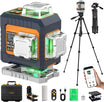


Do You Need a Laser Level Receiver? Check the Job First
You carry your line laser out to the yard, switch it on, and the green line that was crisp across the living room is gone. The accessories page offers a receiver for about sixty bucks [1], and you're left wondering whether that little box brings the line back or just ends up in the bottom of the toolbag.
Rather than guess, we tested it. We took a CIGMAN CM-701 up on a sunny roof, switched on its Pulse Mode, and walked a CLD-100 laser level receiver out across the roof to see where it would lose the beam. Before the receiver, though, there was a cheaper question to answer. How far could we still see the line with our own eyes?

How Far You Can Still See the Line on Your Own
So before spending anything, start indoors, where most people first switch a laser on. The CM-701 lists a working distance of up to 100 ft [2], and in a house the walls run out long before the line does, so for most indoor jobs a receiver has nothing to add. The exception is finish work like hanging wallpaper, where you might want a beep to tell you you're dead on the line; it works, but expect a lot of beeping.
Outside is where it falls apart. On that roof, in late-afternoon sun, the line was nearly gone half a meter from the CM-701 where the sun hit the ground. Once we stood so our shadow fell on the target, we could pick it out to about 5 m (16 ft), but not past 10 m (33 ft). In the shadow of a wall it started fading around 2 m, was still findable at about 10 m, and was gone past 15 m (49 ft).
| Job | How far from the laser | Receiver? |
|---|---|---|
| Cabinets, tile, shelves | A few meters, same room | No |
| A mark or two outside, target in shade | Within about 5 m (16 ft) | No |
| Fence or deck posts in daylight | Past about 10 m (33 ft) | Yes |
| Grade stakes across a yard | 10 to 30 m (33 to 98 ft) | Yes |
| One level across a whole site | Past about 30 m (98 ft) | A rotary laser with its own receiver |
Green doesn't rescue you, either. The CM-701 is a green laser, and it's the one that vanished on the roof. What does help, and costs nothing, is waiting. After dark the line shows up clearly again, so if you only need a mark or two, they can wait until evening.
What a Receiver Gives You Back

Past those few meters, then, what does the box actually hand you? Not the line, and that's the part that catches people out. A receiver is a small box you clamp to a rod or a straight board, with a sensor window on the front, and it tells you with lights and a beep when that window is sitting on the beam [1]. Its job is to catch the beam when there's nothing for you to see it on, which in daylight can be just a few steps from the laser.
It doesn't hunt for brightness the way your eye does. It listens for a pulsed beam, which is why the laser has to be in Pulse Mode before it reacts at all [1], and on our roof it kept hearing the beam long after we'd lost sight of it.
What you get is one height, at the spot where the rod is standing. For fence posts, deck posts and grade stakes that's exactly the job, because each of those is a height at a point. Walk the rod to the next post, slide the receiver until it beeps, mark it, and move on. Nobody has to stay back at the laser. What it won't give you is a line to eyeball, so checking a whole row of pavers at a glance is still off the table.

Reading the rod is simple once you know which way it runs. The receiver sits at the beam, so the number at the receiver is the distance from the ground up to the beam, and a bigger number means lower ground. Take readings at two spots and subtract one from the other, and that's the height difference between them [3]. Before the first stake, though, hold a steel tape against the rod. A laser leveling manual from the International Rice Research Institute warns that some rods' printed scales are off by a centimeter or more [3].

Then there's range. On the roof the CLD-100 beeped steadily out to 30 m (98 ft) and mostly went quiet at 50 m (164 ft). CIGMAN rates it at up to 165 ft (50 m) in poor lighting [1], and a sunny roof is the opposite of poor lighting, so plan on about 100 ft in daylight. For a longer run, set the laser in the middle. With 30 m each way, you cover 60 m, close to 200 ft.
Going farther has a cost, though. The CM-701 is rated at ±1.5 mm over 5 m [2]. Spread that the way the spec is written, 0.3 mm per meter, and at 15 m (49 ft) the beam can be off by up to 4.5 mm, at 30 m by up to 9 mm, about a third of an inch. On fence posts you'll never see it. On a patio you're sloping so water runs off, check the laser before a long run; our guide to fixing a laser level that isn't level walks through the check. Setting up in the middle helps here too, since half the distance means half the worst-case error.
Whether It Will Hear Your Laser
All of that assumes the receiver can read your laser in the first place, and that mostly comes down to one button. Look for Pulse Mode on the keypad or in the manual. On the CM-701 you switch to it from self-leveling mode, and the indicator light keeps flashing the whole time it's on [2], which is normal. If your laser has no Pulse Mode, there's nothing for a receiver to pick up, and the money is better spent on a laser that has it. Our laser level buying guide covers what else to look for when you pick one.
The type of laser matters too. A line laser receiver and a rotary laser receiver aren't interchangeable, and the CLD-100 is built for line lasers with Pulse Mode; it won't work with a rotary laser [1]. If a rotary is what you own, get the receiver made for it.
Beam color isn't a worry with this one, since it reads both red and green pulsed beams [1]. CIGMAN lists the lasers it's meant to pair with: the CM-701, CM-701SE, CM720, CM-801, and CM-S01 through CM-S05 [1]. If your laser is another brand, go by the receiver its own manual names.
If the receiver stays quiet, check the laser before you blame the receiver. Pulse Mode has to be on, and on the CM-701 it doesn't work while the laser is in power-saving mode [2].
At the time of writing the CLD-100 is $59.99, and the 9V battery (about 70 hours) and the rod clamp come in the box [1].

- Line lasers with Pulse Mode only, not rotary lasers.
- Detects red or green pulsed beams up to 165ft (50m).
- 9V battery, about 70 hours, rod clamp included.
What Else You'll Carry
The rest of the kit is short. The CLD-100 comes with a clamp for a rod [1], so you'll want a rod to clamp it to, ideally one with a scale so you can read heights off it, and the laser needs to sit still on something steady, which outside usually means a tripod. The setup itself, step by step, is in our guide to using a laser level outdoors.
One habit is worth picking up early. The CLD-100 switches itself off after about 10 minutes sitting idle [1]. If it goes dark while you're setting stakes, wake it and check it against your first mark before you trust the next reading.
Laser Level Receiver FAQ
Is a laser level detector the same as a laser receiver?
Yes. They're two names for the same tool, the box that senses the beam and signals when it's on it. CIGMAN's own CLD-100 page calls it a receiver in the title and a laser detector in the setup notes [1].
References
- [1] CIGMAN, "CLD-100 Laser Receiver," CIGMAN. Open the CLD-100 product page. Verified October 26, 2026.
- [2] CIGMAN, "CM-701 3x360-degree Self-Leveling Green Laser Level," CIGMAN. Open the CM-701 product page. Verified October 26, 2026.
- [3] International Rice Research Institute, "Laser Leveling Training Manual," IRRI Postharvest Unit, Oct. 2013. Open the training manual. Verified November 18, 2026.



Leave a comment
This site is protected by hCaptcha and the hCaptcha Privacy Policy and Terms of Service apply.